Optical transceivers connect network equipment through fiber-optic links. As data center, enterprise and telecom networks grow, buyers increasingly need to evaluate link speeds from 10G to 800G. Choosing the right module is not simply a matter of selecting the highest available bandwidth. The correct choice depends on equipment compatibility, fiber infrastructure, transmission distance, optical interface and total deployment cost.
1. What do 10G, 25G, 100G, 400G and 800G mean?
These labels describe Ethernet link-speed classes. They do not, by themselves, identify the optical wavelength, fiber type, connector, reach or module form factor. Those details are defined by the particular optical interface or implementation.
| Speed class | Common form factor examples | Typical deployment context |
|---|---|---|
| 10G | SFP+ | Enterprise access, server connections and established data center links |
| 25G | SFP28 | Server connectivity and data center leaf networks |
| 100G | QSFP28 | Data center uplinks, aggregation and high-bandwidth switching |
| 400G | QSFP-DD or OSFP, depending on equipment | High-density data center switching and network aggregation |
| 800G | QSFP-DD800 or OSFP, depending on equipment | High-capacity data center fabrics and demanding AI infrastructure |
These are common examples, not universal rules. A speed may be available in more than one form factor, and a module’s supported interface must always be checked against the host equipment.
2. Why do optical transceivers have different specifications?
Two modules with the same nominal data rate may serve very different links. Important differences include:
- Fiber type: Single-mode fiber (SMF) and multimode fiber (MMF) have different optical characteristics and application ranges.
- Wavelength: The operating wavelength must match the selected optical standard and link design.
- Transmission distance: Reach depends on the optical interface, fiber, connectors, link budget and deployment conditions.
- Optical architecture: Parallel optics, duplex fiber and wavelength-division approaches use different fiber and connector arrangements.
- Electrical lanes and signaling: Higher-speed interfaces may use multiple lanes and different modulation technologies.
Never select a module based only on a label such as 100G or 400G. Review the complete interface specification and the equipment vendor’s supported module list.
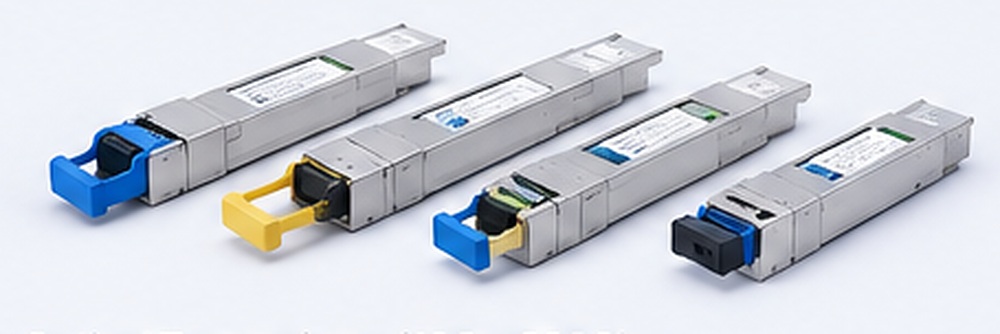
3. Understanding the move to 400G and 800G
Higher-speed Ethernet generations are supported by formal physical-layer specifications. IEEE 802.3df-2024 adds Ethernet MAC parameters, physical layers and management parameters for 400 Gb/s and 800 Gb/s operation. The exact physical interface still matters: different variants can target different media and reaches.
Coherent optical interfaces are another important category. For example, the OIF 400ZR and 800ZR implementation agreements address coherent links for data center interconnect applications. These should not be treated as interchangeable with every short-reach client-side Ethernet transceiver.
4. A practical procurement checklist
- Confirm the switch, router or server model and the exact port capability.
- Identify the required Ethernet rate and whether port breakout is needed.
- Confirm single-mode or multimode fiber, connector type and installed cabling.
- Specify the required reach and optical interface, not just the speed.
- Check host compatibility, coding requirements, firmware constraints and digital diagnostics.
- Review operating temperature, power consumption and installation environment.
- Request the manufacturer’s datasheet and verify the exact part number before ordering.
- Plan sample testing and acceptance criteria before volume procurement.
5. How FEELTONE TECH supports optical transceiver sourcing
FEELTONE TECH helps overseas B2B buyers identify suitable China-based suppliers and coordinate technical requirements for optical transceivers and network equipment. Support can include supplier matching, specification comparison, sample coordination, quality checks and consolidated purchasing coordination. Product availability and compatibility are confirmed against each project requirement rather than assumed across all platforms.
Explore our optical networking and product categories, learn about our China sourcing solutions, or contact our team with your required speed, distance, fiber type and equipment model.
Technical references
- IEEE 802.3df-2024: 400 Gb/s and 800 Gb/s Ethernet
- OIF Implementation Agreements, including 400ZR and 800ZR
Pingback: How to Choose the Right Optical Transceiver | FEELTONE TECH